
Discovering the minimalist beauty of Maharashtra's ancient Warli painting tradition.
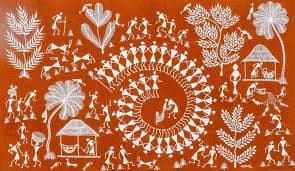
Warli art, from the Warli tribe of Maharashtra, is one of India's oldest art forms, dating back to 3000 BCE. Using simple geometric shapes - circles, triangles, and lines - Warli artists create stunning narratives of daily life and nature.
The Warli Aesthetic
Warli paintings use a white pigment made from rice paste on mud walls. The central motif is often the "chauk" or "chaukat," a square representing a sacred enclosure. Human figures are depicted as two triangles joined at the tip, representing the balance of nature.
Themes and Stories
Paintings depict scenes of farming, fishing, festivals, and dances. The Tarpa dance, where villagers dance in a circle around a musician, is a popular theme. Each painting tells a story of community, harmony, and the cycle of life.
"Warli art is the voice of a tribe that speaks through simple lines and profound stories."
Today, Warli art has transcended tribal boundaries, appearing on contemporary canvases, textiles, and home decor, bringing tribal wisdom to urban spaces.